Help me publish this article “# Coalition of Parastatals CEOs: A Strategic Boost for Tinubu’s 2027 Re-election Bid
As Nigeria moves towards the 2027 general elections, a new political alliance is seeking to reshape how the Tinubu administration communicates its record and mobilises support for a second term. The Forum of CEOs of Federal Parastatals (FORCEPA), comprising heads of federal agencies and parastatals, is positioning itself as a potential bridge between the government’s policy achievements and the public perception of its performance.
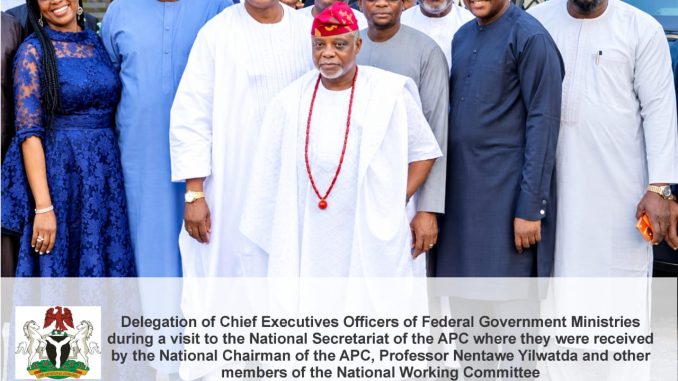
Led by the Director-General of the National Board for Technology Incubation, Dr Kazeem Kolawole Raji, the forum has engaged the All Progressives Congress (APC) National Chairman, Professor Nentawe Yilwatda, and members of the party’s National Working Committee. Its stated objective is to strengthen the communication of government policies and contribute to the mobilisation effort ahead of the next presidential election.
The initiative rests on a straightforward political argument: those responsible for implementing government policies should be able to explain their outcomes, defend their records and help Nigerians understand the reasoning behind major decisions.
For too long, public-sector administrators have largely remained outside the political conversation surrounding the policies they implement. This has often left the task of explaining government programmes to party officials and political spokespersons, even when the technical details and institutional experience needed to assess those programmes reside within the agencies themselves.
FORCEPA is seeking to change that dynamic by connecting policy implementation with public communication. By engaging the APC leadership, the forum hopes to narrow the gap between what the administration says it has achieved and what Nigerians believe it has delivered.
The political significance of this approach lies in the changing demands of an incumbent seeking re-election. In 2023, President Bola Ahmed Tinubu campaigned on promises of economic reform, improved governance and renewed national development. In 2027, the administration will face a different test: persuading voters that its decisions have produced sufficient progress to justify another four years in office.
That argument will require more than campaign slogans. It will depend on verifiable results, credible explanations of policy choices and evidence that reforms are beginning to improve the lives of ordinary Nigerians.
Federal agency heads possess institutional knowledge that could help explain the objectives, implementation and outcomes of government programmes. Their experience could also help identify weaknesses in public communication, correct misunderstandings and bring technical policy discussions closer to communities across the country.
If properly coordinated, FORCEPA could complement the APC’s existing campaign structures by providing specialised policy communication and additional channels for grassroots engagement. Its potential value would lie not simply in the number or status of its members, but in their ability to translate complex government initiatives into clear, measurable outcomes that citizens can assess.
The administration’s economic reform programme offers one area in which this approach could be tested. The International Monetary Fund, World Bank, African Development Bank, Fitch Ratings and S&P Global Ratings have assessed aspects of Nigeria’s economy and policy direction under the Tinubu administration. Their analyses provide different perspectives on economic conditions, fiscal policy, external balances and reform implementation.
However, international assessments should not be treated as blanket endorsements of every government policy or as proof that the benefits of reform have reached all Nigerians. Macroeconomic indicators and the daily experience of households measure different aspects of economic performance.
For many citizens, the most immediate questions concern the cost of food and transport, access to employment, business operating expenses, purchasing power and the ability to meet basic household needs. These are the issues that will shape how voters judge the administration’s record, regardless of the assessments issued by international financial institutions.
For FORCEPA, therefore, the challenge is to connect policy explanations with evidence of tangible outcomes. If the forum is to make a meaningful contribution to the political conversation, its messaging must demonstrate how government decisions affect businesses, workers, farmers, traders and families. Where results are measurable, they should be presented with credible figures. Where challenges persist, those difficulties should be acknowledged rather than obscured.
The calibre and experience of the forum’s leadership will also influence its effectiveness. At the centre is Dr Raji, an engineer with more than 25 years of experience in leadership, project management and technological innovation, according to the profile presented by the author.
Raji, who hails from Oyo State and is popularly known as “Raji KK”, built part of his academic and leadership background at the University of Ibadan, where he served as chairman of Nnamdi Azikiwe Hall, commonly known as Zik Hall. His experience spans technical engineering, business management and grassroots political organisation.
During the 2023 general elections, he served as Director of National Youth Mobilisation for the South-West under the Tinubu-Shettima Presidential Campaign Council. That experience provides a political foundation for his current role in an initiative seeking to connect public-sector leadership with campaign mobilisation.
Another key figure is Otunba Biodun Ajiboye, Executive Secretary of the National Institute for Cultural Orientation (NICO) and chairman of FORCEPA’s Media and Publicity Committee. Ajiboye brings more than three decades of experience in media, advertising and public communication, making messaging a central part of his contribution to the forum.
His position reflects an important reality of modern political campaigns: communicating a record is almost as consequential as compiling it. An administration may implement policies and establish programmes, but its ability to explain their purpose, demonstrate their effects and respond credibly to criticism can influence how those actions are understood by the public.
Ajiboye’s experience in communications and public service could therefore be valuable in helping the forum identify gaps in the government’s messaging and develop clearer ways of explaining its programmes. His argument that the communication effort should not rest solely with the Presidential Campaign Council reflects the forum’s broader ambition to provide additional technical support for the campaign.
Yet effective political communication must be grounded in evidence. Claims about economic progress, public-sector reforms and improvements in living standards are more persuasive when they are supported by transparent data and independent verification. A strategy built around credible information would also give the forum a stronger basis for responding to opposition criticism without reducing every disagreement to political hostility.
This distinction matters because a coalition of public-sector chief executives operates at the intersection of administration and partisan politics. Its members are responsible for institutions that serve Nigerians across political divides. Any political engagement must therefore be clearly distinguished from their official duties, with public resources and institutional authority protected from improper use for partisan campaigning.
The potential contribution of FORCEPA to Tinubu’s 2027 re-election campaign will ultimately depend on how effectively it converts its institutional experience into useful public engagement. A coordinated network of experienced administrators and communicators could expand the campaign’s reach, but its influence cannot be guaranteed by the seniority of its members alone.
The decisive test will be whether the forum can provide accurate information, explain policy outcomes in accessible language and connect the administration’s stated ambitions with the everyday concerns of Nigerians.
For Tinubu’s supporters, the coalition represents an opportunity to strengthen the case for continuity by placing greater emphasis on the government’s record. For the administration, it offers a potential channel for explaining reforms and addressing the gap between policy intentions and public understanding.
Ultimately, the 2027 contest will be shaped not only by the organisation of political campaigns but also by voters’ experiences of governance. FORCEPA may become a significant part of the administration’s re-election strategy if it can demonstrate that the people implementing government policies are equipped to explain their results with clarity, evidence and accountability.
The task ahead is therefore larger than mobilising support. It is about making the case for the administration’s record in a way that Nigerians can scrutinise, understand and judge for themselves.
*Omonu Nelson, a development journalist, writes from Abuja.*
Discover more from NAIJAJOY
Subscribe to get the latest posts sent to your email.




Leave a Reply